
Frontline to Field: Jason Stanford’s Mission to Support Veterans and Their Families
“So that was on July 3rd that took place,” speaks Jason Stanford of his big league call up. “I fly up the next day, July 4th. July 6th, I make my debut and sure enough, wouldn’t you know, right? First stop, I go out and I compete. I go five innings. give up two runs. I come out, it’s tied 2-2, and we end up winning that game. But it was just, it was crazy, you know, to face that lineup. And one of the big moments in the game, bases loaded, two outs, we’re losing 2-. It was the fourth inning and I’ve got a 3-2 count and my go-to pitch was my change-up. Like my fastball was good. It wasn’t great, but it was good. And so I go 3-2 change-up bases loaded, rookie debut. Hits it to my shortstop, Ricky Gutierrez, and he throws it over to first base for the out and we were able to get out of it. And it was just, one of those moments, you know. I go back out for the fifth and go one, two, three. Just everything about your debut, like everybody always asks ‘What was it like?’ It was everything that you could ask for and then some.”
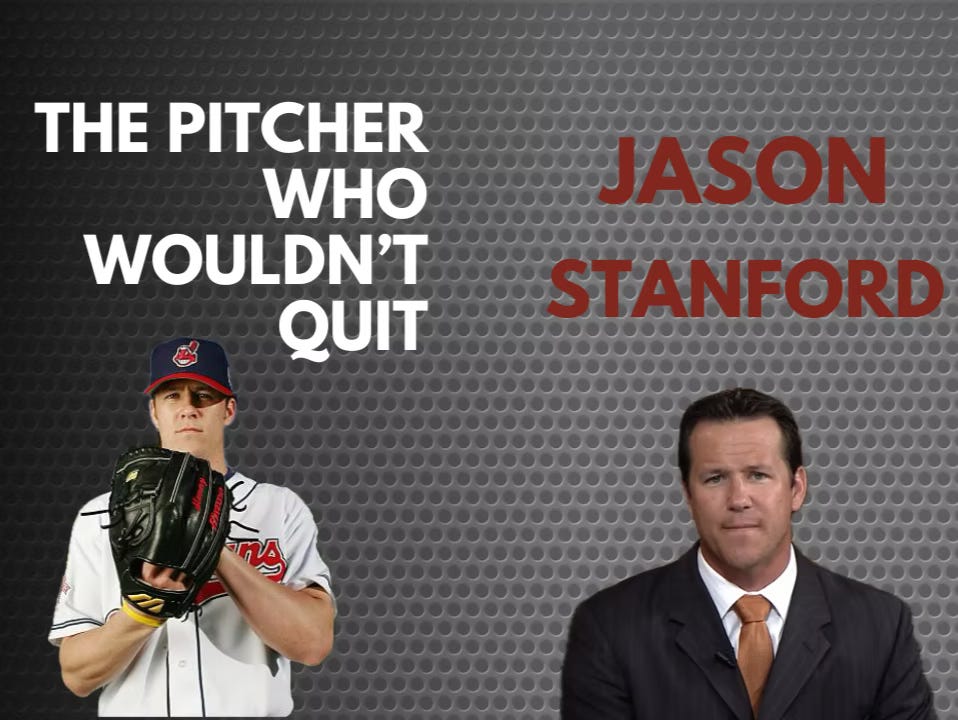
He continues, “My mom and dad were both able to make it. I had eight or nine of my closest friends from elementary school all happened to get out there. A couple of my buddies from college were able to make it out there. And it was just an unbelievable moment and experience and just one that I’ll live out forever, of course.”
Jason earned a spot on the Indians’ Opening Day roster in 2004 as the team’s fifth starter. Adversity found him during his second start of the season. “I feel some twinges in my elbow and sure enough, my second start against Minnesota. My elbow is on fire. It happens as I’m warming up for the fifth inning. I feel some twinges in my elbow. I finish the fifth inning, I finish the sixth inning and then the next day can’t even play catch. I’m put on the DL immediately.”
“They shut me down for six to eight weeks of no throw, Stanford states. “So I’m getting there every day, I’m rehabbing, missing out. Jake Westbrook at that point takes my rotation spot and he goes off, he had a great ‘04 season. Later in the season, I start traveling with the team again, getting close to coming back, thinking that I’m healthy. I’m doing long toss, all this stuff, throw bullpens. We go on a road trip to Seattle and Anaheim. After the Anaheim trip, we were gonna reassess and then kind of make a decision at that point. So I throw my bullpen in Seattle. I felt fine. At that point, I’m gonna do a live simulated game in Anaheim. It was at the moment that I do the live simulated game and I tried to ramp up a little bit and I couldn’t. At that point we go sit down with the orthopedic locally and he says, ‘Through the testing, I think that you have a tear or a fray in your ligament.’”
The next step was a trip to Birmingham, Alabama for a visit with the renown Dr. James Andrews. Dr. Andrews confirmed the tear. He performed Stanford’s Tommy John surgery the next day, Thursday July 29, 2004.
“I start my rehab right away the next morning,” Stanford remembers. “I wake up and feel really groggy, and I start my rehab process right then and there down in Birmingham. It was a long recovery, it was a long road. I would not change it for anything. The reason I say that is, it really defined who I was trying to make a comeback, right? So throughout the whole process of playing professional baseball, it was always a grind. It was always, I had to prove myself. I had to prove myself and you know, at each level I did. This was just another roadblock. For me, it was how to get healthy, but not fast, make sure that I was completely healthy and how to get back to the big leagues and be able to help.”
Jason Stanford made a fifteen appearances across the Indians minor league system in 2005. “Velocity was back to being what it was, 89 to 91, and it was cool. The thing that was lacking though was my breaking ball, wasn’t as sharp as it was before and my changeup was kind of flat, you know, and my changeup was my big pitch. So having that flat, you know, was just something a little bit different that I had to get accustomed to.” He’d finish his comeback season strong, with AAA Buffalo, he made 4 appearances (1 start) and recorded a 1.29 ERA with 7 strikeouts over 7 innings worked.
Stanford began 2007 with the Buffalo Bisons. “I go back down to AAA to start and I put together some really strong numbers early on in 07. At that point we had a young pitcher, Jeremy Sowers. He was the next phenom to come through the system, first round draft pick from Vandy. He goes up and he kind of struggles up in the big leagues. So, midway through the season, I’m pitching extremely well and consistent. We’re in Richmond, Virginia and Scott Radinsky is our pitching coach. And he’s like, ‘Hey, grab a bat, grab some batting gloves. Ewe need to go to the cages and you need to hit a little bit.’ Sure enough, right after the game, Torey Lovullo calls me in the office and Torey tells me I’m going to Miami tomorrow to pinch against the Marlins. I go down, pitch against the Miami Marlins and was able to get my first win coming back from Tommy John.”
“And again, you know, we’ve talked about those first starts, right? At every level. Well, sure enough, that first start, I go into the seventh inning, I give up one run, I even lay down a sacrifice bunt against Dontrelle Willis.”
Jason made one more start. He gave up three runs in the first inning, but was able to pitch through 6.2 innings, allowing 6 earned on the day. The Indians moved him to the bullpen. He had good outings mixed with some bad, but coming out of the ‘pen didn’t fit Stanford. Most successful relievers have dominating velocity or at least a wipeout pitch.
Stanford was granted free agency at the end of the season. The Washington Nationals picked him up prior to 2008. After struggling over eight appearances with the AAA Columbus Clippers, he was released by the Nationals.
His old friends, the Cleveland Indians, called with an offer (with a catch.) The team had a hole at AAA, but that hole would likely be temporary when several pieces of their long-term puzzle were expected to return to the mound. It was the eighth season in which Jason would take the mound for the Buffalo Bisons, but it’d only last a month.
His next stop for 2008 was Potros de Tijuana of the Liga Mexicana de Beisbol. Translated, that means he was pitching for the Tijuana Colts of the Mexican Baseball League. Stanford loved the experience of playing south of the border, but the Chicago Cubs reached out to his agent. He would finish the 2008 season making 7 starts with the AAA Iowa Cubs.

I get a call from, a Taiwanese team, asking if I could, be of their services and, they send over the contract. I look it over, at that point, my wife at the time was a lawyer.
“I was getting ready to sign to go play in Taiwan and try to regenerate my career overseas. Once we were getting to the finalization of signing the contract, we found out that my family was not going to be able to go over there, being that our daughter was less than six months old.”
Being across the world from his wife and newborn daughter was very unappealing to Jason Stanford. He decided to conclude his career as a professional baseball player.
What was next for Stanford? “I started teaching baseball lessons and then I opened up my own academy [Stanford Baseball Academy.] I wanted to stay in the game professionally. I reached out to the Indians and asked them if they had any opportunities on the coaching side. They didn’t because, at that point, that was January or February, they were set for the year. But Mark Shapiro [then, Indians General Manager] told me to reach out to their TV station and radio station and just to see if there was an opportunity there. And so I did. It was kind of crazy because Brian Anderson, the left-handed pitcher that’s currently the analyst from the Rays was doing color and pre and post for the Indians. And when he got that job with the Rays, it opened up a position in 2009 with the Indians. I reached out and kind of did a mock interview, then did a formal interview, and then got on the air and did a couple shows. They were like, ‘Hey, just be yourself, talk baseball, and have commentary with our host.’ So one thing led to another, got the job that year and did the pre and post.”
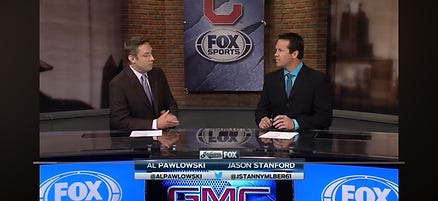
“You have to do a lot of homework and studying of the players and whatnot,” explains Stanford. For me it was trying to walk that fine line without being too critical of the players, but also get a point across. You still gotta go in the clubhouse, you still gotta face these guys daily. Yes you’re a player and yes they know who you are but, at the same time, if you start criticizing guys about why they’re not doing this or that, now all of sudden they don’t want to talk to you. So it was, it was a fine line and a lot of it was talking and getting to know the players, even though I already knew them, but kind of explaining my position on how I was going to present things on the air. And they were good with that. I just told, told the story of what guys go through on a daily basis.”
Stanford held this role with the Indians for seven seasons, until SportsTime Ohio was purchased by Fox. Despite his show exceeding every performance metric and ratings goal, Fox brought in their own people. By the time Fox made their decision, it was December. Every other team already had their people in place.
While Jason was doing his work in TV and radio, he was also working with high school players. Now, with a little more time on his hands, he opened his instruction to younger players. His mission was to develop men, not just baseball players. He, himself, learned to be an effective fundraiser, raising money to provide equipment and scholarships to kids that wouldn’t otherwise be able to stay in the game.
Jason Stanford Giving Back to the Game of Baseball
2:09
“I had some really good kids that they were, decent baseball players, but they were great kids,” Stanford acknowledges. “They respected everybody. They showed up on time. They worked hard. They were unbelievable in the classroom. And the families, the parents, allowed myself and my staff to do our job. They just allowed us to do our thing. And the bulk of those kids went on and they played collegiately.”
In 2018, an opportunity presented itself for Jason Stanford to return to the pro ranks as a pitching coach. Neil Huntington, who was the Indians’ Farm Director when Jason began his pro career, was now the General Manager of the Pittsburgh Pirates. They had an opening for a pitching coach with their short-season West Virginia Black Bears.

“A couple other guys from the Indians were actually over there as well,” says Jason. “Made the transition nice. I will tell you that first year, you think you know so much about baseball. I did not know anything. I knew how to play. I knew how to compete. I did not know the coaching aspect of it and how long staff actually stayed working. And that was I will tell you and anybody listening. That’s an eye opening experience to say the least. I was really fortunate because I was strong playing as an attention to detail player. So that transitioned myself over to the coaching aspect of it. So tons of notes, tons of video, too much information from these guys. You might have all this information that you want to unload on them, they might just need one thing to get them where they need to be.”
The Atlanta Braves caught wind of Stanford’s reputation as a being knowledgeable with strong attention to detail. For 2019, they offered him a full-time job as pitching coach of the Danville Braves, with added responsibilities with their young pitchers. Stanford loved the position and his place within the game that he loved, but the time away from family was depressing.
And then,.....
COVID HIT.
The cancellation of the minor league season meant Jason no longer had a job. Again, he was a free agent. Jason returned to Ohio and his previous role with youth travel teams and the Stanford Baseball Academy. His son was now 9 years old and was beginning to excel on the baseball field. Jason’s travel teams are always set up as nonprofit organization. He’s more interested in helping his community and seeing kids enjoy the sport than he is making a fortune.
Frontline to Field: Jason Stanford's Mission to Support Veterans and Their Families
A little over a year ago, Jason Stanford established Frontline to Field, a nonprofit dedicated to serving veterans, first responders, their families, and the next generation of youth baseball players.