


J.D. Scholten: Bullpens and Ballot Boxes
- Jeff Perro

- Jan 3
- 10 min read
The unlikely dual life of J.D. Scholten. How a 45-year-old pitcher balanced professional baseball, elected office, and an unshakable loyalty to home
When J.D. Scholten retired from professional baseball in December 2025, he did so at age 45—an age when most players are already several years removed from the grind of daily training, scouting reports, and late-night bus rides. At the same time, Scholten was doing something no one else in baseball history has done.
“I’ve been a state representative for the last four years now,” Scholten said. “And so I’m the only person to ever
play professional baseball while also serving in an elected official position.”

That combination of professional athlete and public servant is not a gimmick in Scholten’s story. It is the result of a life built on persistence, adaptability, and a deep connection to Sioux City, Iowa, the place he has always called home.
Sioux City, Always
“You were not born in Sioux City, but you were raised in Sioux City, college baseball in Sioux City, you were representing Sioux City, and you played professional baseball in Sioux City,” interviewer Jeff Perro noted. “That’s your town. That’s your home.”
Scholten didn’t hesitate.
“I love what Sioux City has been able to do for me,” he said. “And just like anything I can do to give back. So both down at the Iowa Capitol and then the last couple years wearing Sioux City across my chest on the baseball field again. It means a lot to me because Sioux City means a lot to me.”
That loyalty runs through every chapter of his life, from his earliest days on the mound to his improbable final act with the 2025 Sioux City Explorers.
From Morningside to Nebraska
Scholten’s baseball journey began at Morningside University, then called Morningside College (also the alma mater of Kory DeHaan,) where his father was the head coach. “So back then it was called Morningside College. It was a Division II school,” Scholten recalled. “My senior year, that’s when they converted to NAIA.”
He pitched three years there and did enough to attract draft interest, the Angels offered him a thousand bucks, but he chose a different path. “I turned it down. But, I did all I could at that level and that’s when I decided to go to the University of Nebraska.”

Nebraska had just been to the College World Series, and Scholten wanted to test himself. “They made the College World Series the year before I got there,” he said. “And they were going to have a really good team again. So I thought I would go there and try my talents at a Division I school like that.”
“We were a scrappy ball club,” Scholten said. “Guys would tell us later, ‘Man, we hated playing you guys. You just grinded it out and did everything right.’ We put pressure on teams for nine innings, regardless of the score.”
Despite leading Nebraska in ERA, Scholten didn’t hear his name called on draft day. “I was kind of surprised I didn’t get drafted,” he said. “I didn’t have a lot of innings down at Nebraska. I led the team in ERA, but didn’t get a lot of opportunities.”
Pro Baseball, The First Time Around
Instead of walking away, he found opportunity wherever it existed.
“I ended up getting to play in the Canadian Baseball League [with the Saskatoon Legends in 2003,]” Scholten said. “They were just starting up and they gave me an opportunity, so I jumped at that.” There, he played for manager Ron LeFlore, a former MLB All-Star, on the same pitching staff as Major League veteran Floyd Youmans.


“Floyd Youmans was 39 years old at the time,” Scholten recalled. “He wasn't blowing it past guys like he did when he was in his prime, but he just he knew how to pitch and get outs. That rubbed off on me."
That lesson would echo two decades later.
The Canadian Baseball League folded midway through the season. Scholten was picked up by his hometown Sioux City Explorers of the independent American Association. He'd pitch an unremarkable season and a half with them.

After that stalled period in his career, a random decision changed everything.
“After the '04 season, I thought I was done," he says. "I always knew in my heart there was more, but I didn't know what. I kind of plateaued out things just things weren't working. And so I moved up to the Twin Cities. I was working at a bookstore in St. Paul. There was a winter night during a storm, not too many people in the store. I got online and found a website that showed a team in Belgium needed a pitcher.”
He sent an email with no expectations.
“When I woke up the next morning, I had an email back,” Scholten said. “Two weeks later, I was on a flight to Belgium.”
That opportunity restored his confidence. “I pitched really well over [in 2005] there and got my confidence back,” he said. “Sometimes you just need innings underneath you.”
With the added experience, Scholten returned to the mound for his hometown X's. He pitched well for the team in 2006, but struggled through 2007.
"I don't know what happened, but hit a brick wall and I couldn't get outs," confessed Scholten. "So I thought, 'You know what, I need to move on with life.' But then there was a couple other opportunities to go play in Europe. So I took those."
Over the next few years, Scholten pitched in Belgium, France, and Germany—a bit out of necessity, mostly out of curiosity.
"Then I got an opportunity to move to Seattle, for work. At that time I was working as a paralegal and had a good opportunity there."
He'd link up with a high-level amateur league in the Pacific Northwest and continue to play competitively through 2013.
Politics Enters the Picture
Scholten’s political journey began far from Iowa.
“I was living in Seattle when the 2016 election happened,” he said. “Being a Democrat, I saw what happened in the nation and what happened in Iowa. I just think our nation works best when we have a healthy two-party system.”
But the real catalyst was personal.
“My grandma is my biggest inspiration,” Scholten said. “She said on her deathbed, ‘You’ve got to move back to Iowa and you need to take care of our farm.’ That really hit home.”
He returned without a clear plan, but eventually decided to run for Congress. “I didn’t necessarily move back to run for office,” he said. “I just wanted to do more. I campaigned for about 16 or 17 months. It was a grind. Baseball taught me how to show up when you don’t have your best stuff.”
Though he lost, he discovered something important. “I found out I was actually decent at it,” he said. “When you love where you’re from, you’re going to fight for the people who make it work.”
He later won a seat in the Iowa House of Representatives.





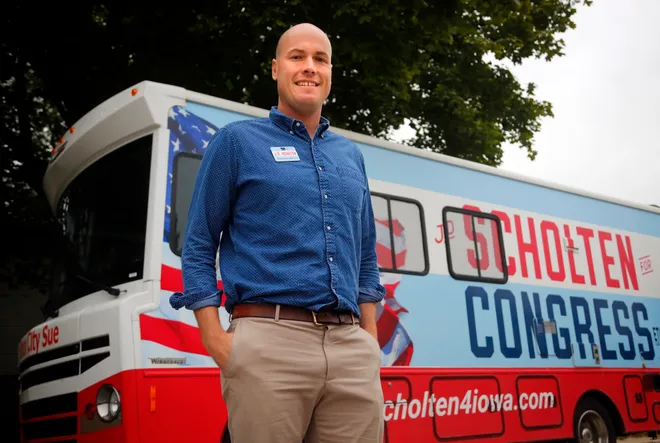


“I consider myself a blueberry in a bowl of tomato soup,” Scholten said. “I’m the only Democrat in 42 counties in Northwest Iowa. It's, an uphill battle in Western Iowa to be a Democrat here, but at the end of the day, it's important to have a strong voice just no matter where you're at. ”
J.D.'s found this career to be very fulfilling. He says, "I find it pretty meaningful, like stuff that you don't see. There's people who reach out to me who just need help getting connected to an agency because a check wasn't coming or they had an issue with Medicaid. Those are the type of things that are really impactful, just helping out your neighbor. That's why you want to do this."
The Seven-Year Itch
"I didn't touch a baseball for seven years. And then COVID hit," starts Scholten. "I'm probably having too many whiskeys on a Saturday night and I went down a rabbit hole of pitching mechanics, because that's kind of the nerd I am. So the next day I buy a couple dozen balls and a net and just start throwing on my own. And you got to remember this was, I was 40 years old at this point. I was also running for U.S. Congress. After I lost that race, the next summer I started playing Town-Team baseball in Minnesota again."
For those who are not familiar, The Minnesota Baseball Association is another very competitive amateur league, commonly referred to as "Minnesota Town Ball." J.D. suited up for the Lyons Pub Warriors.
"I wish every state had what Minnesota does when it comes to town team baseball you you have these just beautiful fields They sell beer for a buck. They get a hundred fans. It's like a pure Americana."
After two years of playing in Minnesota and throwing really well, Scholten decided to reach out to a few teams.
"My friend who played in the Netherlands, he connected me to a few teams," Representative Scholten recalls. "I was talking to the Oosterhout Twins, we got really close to coming to an agreement and then it ended up not working out. I went through my first year in the legislative session, get done with that, back playing with the Lions Pub Warriors. And then they [the Oosterhout Twins] gave me a call on my way to a game where was pitching. They said, 'Hey, we had a couple injuries to pitchers and we have a visa issue, one of our Japanese pitchers has to go back. Would you be interested in coming over and helping us get to the playoffs?' I went over there and it was a unique experience. I learned a lot about what I needed to work on. I learned a lot about myself pitching wise and it was a great experience for me."



The Call That Made History
In 2024, at age 44 and having chosen not to return to Oosterhout, Scholten was again pitching for the Lyon's Pub Warriors. And he was throwing the best he ever had.
“I was 9-0,” he said. “I felt like I was throwing the best I ever had in my life.”
Then, on July 6, everything changed.
"We have this huge music festival in Sioux City called Saturday in the Park," Scholten recalled. "It's in my district. I volunteer there every year. My friend was having a pre-festival party. So, we swung by there. I drank my beer, my girlfriend drank half a beer and I finished it. Then I had to go volunteer. Maybe it was a couple hours in, I just get done delivering some ice and I check my phone just to see what time it is. And, oh crap, I have 10 missed calls. They were from [Explorers' Manager] Steve 'Mongo' Montgomery and [Pitching Coach] Bobby Post."
“They said, ‘Can you pitch for us today?’”



The Explorers had given up 34 runs over the previous two games and the pitching staff was exhausted. Less than 24 hours removed from heavy training, 30 minutes of sprints, leg day, and a beer or two, Scholten headed to the ballpark.
“My mindset was, I’m not going to impress anybody with velocity,” he said. “I’m going to do it with location and changing speeds.”
He gave up a run in the first on a single, stolen base with throwing error on the catcher, and a sac fly. He said, "Two batters in and I'm down 1-0. I told myself, ‘JD, just get through this. Don’t get hurt,’”
Then he settled in.
He went six and two-thirds innings, allowed just two runs, and earned a win.
"It went initially from 'Thank you for showing up for being here and just being a body.' To, in about the third or fourth inning, it was, 'What are you doing in five days?"
With two outs and a runner on first, Mongo made a visit to the mound. Scholten was at an even 100 pitches. Mongo told J.D. that the crowd wanted to give him a standing ovation, obviously. That meant he could either come out of the game now or get out of the inning and pitch to a batter in the 8th. J.D. made what he describes as "the mature decision."
He went six and two-thirds innings, allowed just two runs, and earned a win. The crowd was on their feet. Shortly after, ink was on a contract.
The J.D. Scholten story was everywhere by the next morning; ESPN, Sports Illustrated, MLB.com, MSNBC, Baseball America, USAToday.....

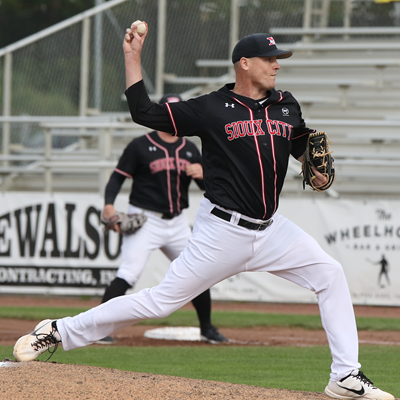


"The next start, the start in Fargo is less documented, but that was a bigger deal to me. Fargo was one of the top teams in the league. We played a four game series and we lost three games. I'm pitching the getaway day, day game. I ended up going six innings, only gave up one run and their one run was a two out bunt with a guy on third base for a base hit. I pitched better that game than I did my first game."
A Blueberry in the Clubhouse
“Baseball clubhouses are historically very red places,” Perro noted.
Scholten agreed, but said it was rarely hostile.
“Politics isn’t at the forefront of most guys’ minds,” he said. “Guys would come up to me during batting practice, not in front of everyone, and ask questions. I think we see politicians on social media or on TV, but not too many of these guys had an opportunity to just have a conversation with someone. 'Why did you get into politics?' and 'What's your reasoning for doing some of this stuff?' or 'Why is it this way?" and things like that. I think it allowed a conversation that is more needed in America and in general."
Knowing When It’s Time
Scholten pitched effectively for the Sioux City Explorers through the rest of the 2024 season. He'd rejoin the team in June 2025 after the legislative session ended. He broke his own record as the oldest pitcher in league history to earn a win. But eventually, reality caught up.
"Mongo came to me at the end of the year, 'We're going up to Winnipeg. You're getting one of those starts.' It allowed Kyle Marman, who was our number one, to get a rest before going into playoffs. He had a great year. We played four games up there out of the four starts. I think I had the second best, which I'm proud of and got a W. So I broke my own record for oldest guy in league history to get a win. So that was my last start. I had my parents at the game. They drove up to Winnipeg to see it. It just kind of made for, you know, it might be a good opportunity to step away at this point."
“It’s hard to play professional baseball,” he said. “It’s hard when you’re 45. And it’s really hard when you’re running for U.S. Senate as well.”
After a torn bicep while hitting in a 40-and-over tournament, the decision became clearer. “I have no doubt in my mind I could play one more year,” Scholten said. “But when you’re 45, there’s life.”

J.D. Scholten announced his retirement from professional baseball on December 16, 2025 at the age of 45.
Writer's note: I've been fascinated by the J.D. Scholten story since 7/6/2024, when he made his comeback with the Explorers. I contacted him the day after he announced his retirement and interviewed him 5 days later. Thank you, J.D., it was an absolute priviledge.


Comments