


"I Define Myself More As a Firefighter than a Baseball Player" - Retired OF Jordan Danks
- Jeff Perro

- Mar 14, 2025
- 7 min read
Updated: Nov 13, 2025
Jordan Danks didn't have a clear path after deciding to retire from pro baseball. He tried real estate, that was pretty cool. He did baseball lessons, that was fun. A freak accident and a chance encounter sent him into a career path that was finally satisfying.
Foreword By Jeff Perro
When I first came up with the idea for Catch Up with JP, I imagined it as a website, a place to write up interviews with former pro baseball players . Maybe later I’d turn it into a podcast. But when I sat down to record a casual phone call with my old friend and former Birmingham Barons outfielder Jordan Danks, it was a great conversation that I decided to just go for it. That conversation became Episode One, and it’s where this whole thing began.
It had been sixteen years since I last saw Jordan. Back in 2009, I was the home clubhouse manager for the Barons, the Double-A affiliate of the Chicago White Sox. Jordan was a young outfielder then, climbing the ladder toward the big leagues. In the years since, he reached Chicago, spent time with the Phillies, and eventually transitioned to a life outside baseball. What I discovered in catching up with him was a story not just about baseball, but about identity, family, and rediscovering purpose after the lights go out.
Climbing the Ladder
Jordan Danks was drafted by the Chicago White Sox out of the University of Texas in 2008. “Coming out of college, I started in A-ball,” he recalled. “I didn’t have to go through rookie ball, so I kind of started in the middle of the pack.” In his first full season, he began at Winston-Salem before being promoted to Birmingham and then on to the Arizona Fall League that same year.

Things moved fast. By 2010, Danks had reached Triple-A Charlotte, putting him one step away from the majors. But like so many players, he found himself stuck there for a few years — not quite breaking through. “I put up a couple of mediocre seasons,” he admitted. “I didn’t get the call until my third year there in Triple-A.”

That call finally came in 2012 while the team was in Toledo, Ohio. “I remember getting the call and everyone said, ‘Don’t play tonight, you could get hurt.’ But I couldn’t pull myself out of the lineup. That’s just not who I was. So I played one last game, I went one-for-three with a home run. One more for the road.”
Welcome to the Show
When he arrived in Chicago, it all hit him at once. “I’d been in big-league camp before, but this was for real. I remember walking into the ballpark and realizing, ‘I’m actually about to play against the Houston Astros.’” His first at-bat ended with a sharp liner that was robbed by a diving Brett Wallace, a college teammate, but he collected his first major league hit later that day, a broken-bat single he still remembers vividly.
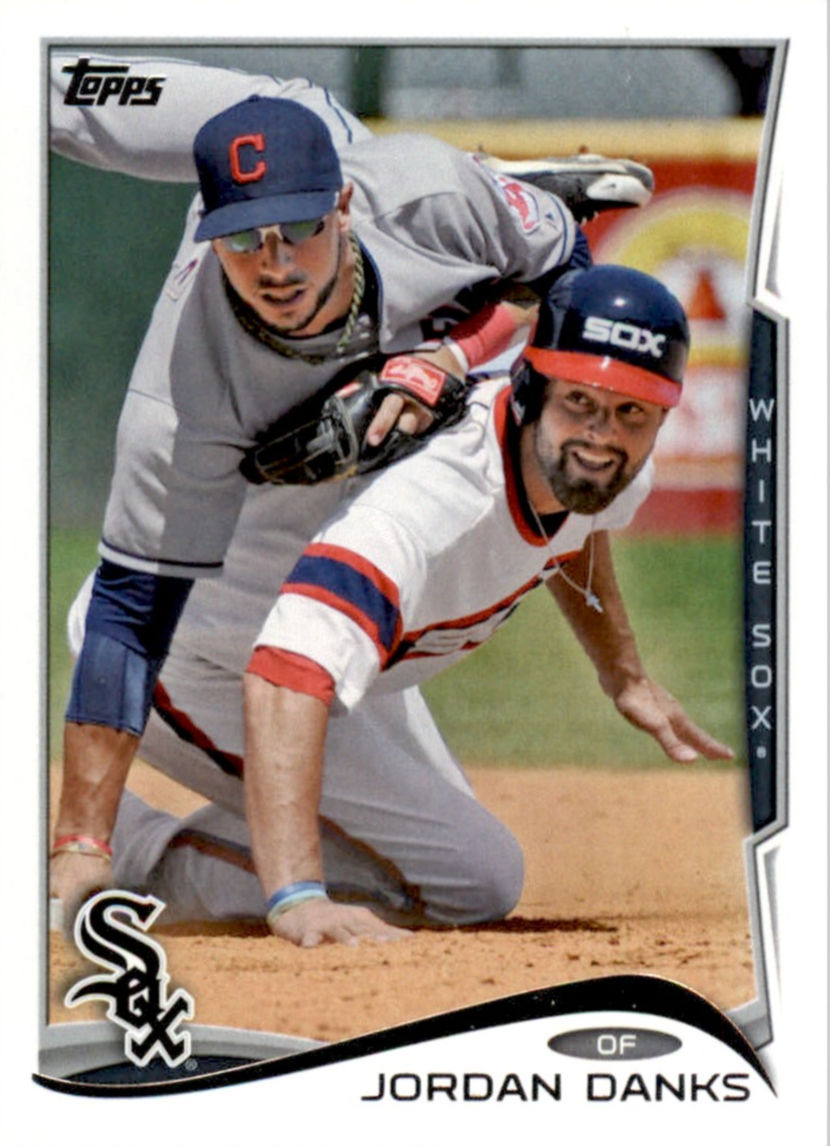
Manager Robin Ventura eased him in by using him as a pinch-runner first. “He was good about that,” Jordan said. “Anytime a guy got called up, he wanted to get you in there quick — get the butterflies out.”
He stayed ready, and that paid off. One of his most memorable moments came when he hit a go-ahead home run while his older brother John Danks was on the mound. “I didn’t even start that game,” Jordan said. “Avisail Garcia ran into the wall and had to come out, so I went in. It was a 2–2 game. My first at-bat, I hit a solo homer and that ended up being the difference.” The Danks brothers became the first siblings since 1955 to record a win and home run in the same game.


Jordan still has a framed display his wife made, "It's got baseball cards of me andmy brother and then the baseball cards of the brothers that had done it in 55, Billy and Bobby Shantz. I got ticket stubs from that same game and then I got a baseball that I had the actual baseball, the home run I hit. I had it authenticated and my brother and I both signed it. It’s one of my favorite things I own,” he said.
The Grind of the Game
For several seasons, Jordan bounced between Charlotte and Chicago, the up-and-down life that defines so many pro baseball careers. “My wife packed up the apartment more than once,” he said, laughing. “She’d load up the kids and the dog, drive up to Chicago, and then we’d get sent back down again. It was a whirlwind.”
Jordan met his wife in eighth grade, and the two began dating after high school. She was a college volleyball player, so they knew what it meant to live the athlete’s lifestyle. “We did the long-distance thing,” he said. “She played at Lamar University, I was at UT. We got married in 2010, so she’d been there through it all.”
The End of the Road
By 2015, the constant travel and roster shuffling began to take its toll. After being placed on waivers by the White Sox, he was picked up by the Phillies, spending most of that season with Triple-A Lehigh Valley. A brief stint with the big club followed, but by season’s end, he was a free agent.

He gave it one last try in 2016 with the Texas Rangers. “I told my agent, ‘See if the Rangers are interested,’” he said. “If I’m not going to make the big-league squad, at least the Triple-A team is in my hometown of Round Rock.”
But late in camp, the Rangers signed Ian Desmond and Jordan’s former college teammate Drew Stubbs. The trickle-down effect left no room. “They called me in and said, ‘You’ve played in the big leagues — we’re not going to send you to Double-A.’ They didn’t know it, but in my mind I’d already decided if I didn’t make the team, that was it.”

He was released soon after. “I wasn’t completely ready to hang it up,” he said. “But I was tired of dragging my wife and kids all over the country. I’d reached my goal — one at-bat in the big leagues. I’d done that and more.”
Life After Baseball
Like many players, Jordan faced the question of what comes next. “That was the scariest part,” he admitted. “I didn’t finish my degree, and baseball was the only job I’d ever had. My résumé was basically: ‘played baseball.’”
A neighbor across the street suggested real estate. “He told me to get my license, and he’d mentor me. I jumped into the books and had my license within two months.” The work wasn’t easy. “It’s like baseball in a way, you get out what you put in. Those first couple of years were a scramble, but I figured it out.”

Jordan noticed something interesting during that transition: “A lot of ex-players end up in real estate or finance. It makes sense — it’s competitive, and we’ve all spent decades with that mindset.”
He still holds his real estate license today, but life had another twist in store.
Trading Batting Helmet for a Fire Helmet
About three years ago, while giving hitting lessons at an indoor baseball facility, a ball got loose, hit a sprinkler head, and flooded the place.

“We had to call the fire department,” Jordan said. “I got to talking with the lieutenant who came out. I was like, 'Are y'all hiring?'"
The lieutenant said they're doing their first ever civilian cadet academy Just get on the website and apply. "And I did, I applied and I showed up for the first exam, just an entry level exam with like 450 other people. I passed that exam and I move on to the live interview process. They called me after that and they were like, 'Yeah, we'd like for you to come on.' I went to their six month academy, passed all the appropriate exams, and for the last three years [since 2022,] I've been a firefighter in a town north of Austin called Pflugerville."


“I love it,” he said. “It’s the same kind of camaraderie as baseball. You’ve got your crew, you train, you stay in shape, and when the bell rings — you go to work. It’s a rush. I say that all the time, I had two of the coolest job descriptions ever. I was a professional baseball player and now I'm a firefighter. I enjoyed the heck out of it, man, and I actually, I define myself more as a firefighter than a baseball player. ”
Lessons and Perspective
I asked him what advice he’d give to 18-year-old Jordan, fresh out of high school. His answer revealed the thoughtful side behind the athlete. “I had the chance to go pro right out of high school, but I turned it down. My brother John was already in Double-A at 17. But I saw what it was like. Guys in their 30s still chasing that first call-up. It scared me.”
He chose the University of Texas instead, betting on education and experience. “Less than 1% of guys drafted make it to the big leagues. I was realistic. My brother always knew he’d make it, I wasn’t so sure. I wanted something to fall back on. Looking back, that was the right call.”
Later, I flipped the question: what would he tell his 28-year-old self — the version trying to hold onto the dream during those last years in the minors?
“Don’t take anything for granted,” he said. “You think you’ve got time, but it ends fast. I thought I’d play ten years in the big leagues. It didn’t happen. And when it’s over, it ends quickly.”
Still, he has no regrets. “Baseball gave me everything — experiences, relationships, even a head start in life. I didn’t make millions, but I got to live my dream. And now I get to do something just as rewarding.”
He pauses, reflecting. “You don’t realize you’re in the glory days when you’re in them. That 2014 Charlotte Knights team, that was one of the most fun years of my life. I’d go back in a heartbeat.”

Full Circle
Today, Jordan Danks is a husband, father, real estate agent, and full-time firefighter. His oldest son plays baseball; his youngest takes guitar lessons. Life is quieter, steadier, but no less meaningful.
For Jordan Danks, it turns out the next chapter after baseball isn’t about leaving something behind — it’s about finding new ways to chase purpose, to compete, and to serve. Whether it’s patrolling the outfield grass or answering a call at the firehouse, one thing remains constant: when it’s time to go to work, Jordan Danks shows up.
This episode is available for download on Apple Podcasts, Spotify, and anywhere podcasts are found.
Shorts taken from this full interview are also available at our YouTube channel and all social media pages.


Comments